|
"A Christmas Wedding" |
|
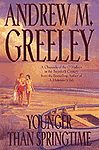
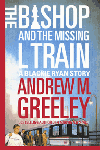
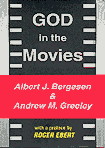
I began to write the O’Malley chronicle with the ambitious idea that I would portray the life of American Catholics in the 20th Century through the eyes of my own generation. So Chuck O’Malley, if he had lived in God’s world as well as mine, would have graduated from St. Ursula (St. Angela) grammar school in 1942 just as I did. In A Midwinter’s Tale we see him cope with the Depression, the War, military service, love, sex, and his eventual return to "postwar" America to discover that the depression was over, and his plans for a quiet accountant's life with its suddenly limitless horizons. In Younger than Springtime he struggles towards adulthood and experiences conflicts about career, love, and the awareness that he is different from his contemporaries. He feels guilt about his lost German love and powerful attraction towards his beautiful, strong-willed and very dangerous foster sister Rosemarie. He also explores the story of his parents romance and thus brings us back to the first decades of the century. He still wants to be an accountant, but Rosemarie thinks he’s a genius and is convinced that he should be a world famous photographer. I agree with her because that’s how he’s going to be present at the great events of the second half of the Century. Into the Fifties In the new book, there is indeed a marriage at Christmas (you’ll have to guess who the bride is) and Chuck settles down to the nineteen fifties, utterly unprepared to be a husband, a father, and an artist. Moreover, his wife’s drinking problem grows worse as does Chuck’s guilt about his German love affair before he was married. He realizes that he will have to put the marriage in danger if only to protect his swarm of five children. The book ends in the early Camelot years, with Chuck going into public service, filled with his liberal Catholic ideals and high hopes for himself and his family. The Sixties The next book in the chronicles, September Song is about disillusion and failure. The civil rights movement, in which Chuck and his wife have been involved, turns violent. The Vietnam war tears the country apart. The birth control encyclical shatters the illusions created by Vatican Council II, Watergate rocks the country, and the younger O’Malleys are caught up in the turmoil of youth culture. Chuck himself goes off to "Nam" to photograph the horrors of the war. He manages in his usual picaresque way to bungle in and out of danger. Their oldest child disappears into the counter culture world and, her brother is reported dead in Vietnam. In this fourth of the O’Malley Chronicles, the narrator is Rosemarie, my first venture with a woman’s point of view. Rosemarie is, her own admission, the craziest of all the crazy O’Malleys. Everyone else, however, realizes that she is the salvation of all of them. So now you know who the bride is in A Christmas Wedding! Nuala Anne returns to Ireland Note carefully the cover picture on the opposite page. The art people are beginning to get it right. Fiona, the snow-white wolf hound, actually looks white, though not enough. Nellie Coyne, Nuala Anne’s first born, actually looks like the lass on the cover. However, Dermot Michael Coyne does not look like a retired line-backer and herself is far more gorgeous than the woman on the cover. This time they must solve the mystery of a judicial murder of an Irish leader at the end the of the missing train, the little bishop’s heart really isn’t in it, not even because he himself could be the prime suspect! And then to Paris! Next summer Blackie goes to Paris to hunt for a missing French TV priest who has disappeared from the face of the earth in a crypt beneath Notre Dame du Paris. I think the book — The Bishop and the Beggar Girl of St-Germain des Pres — has the best plot I’ve ever devised. I defy you to solve it! Some Sociology too In order to keep out of more trouble, I’ve worked on sociology this year. The first volume, God in the Movies, written with my colleague Professor Albert Bergesen from the University of Arizona and based on a course we teach at the University, examines films in which God either appears on camera or lurks just off camera. We find the God of the movies to be very much like the God presented in the scriptures, the God of Jesus, the God of Isaiah. My friend Roger Ebert has written an introduction. Finally, in The Catholic Imagination, I trace from theological writings (especially those of David Tracy), works of art (fine and lively), and from sociological data, the outlines of the imagination which makes Catholics different and holds them in their heritage and their church. |
 |
|
 |
||
| To purchase the most recent Andrew Greeley novel |
||
 |
||
 |
||
 |
||
 |
||
 |
||
Check out Andrew Greeley's Columns for the Chicago SunTimes's Daily Southtown.
|
||