|
|
|||
|
I'm a Catholic. You got a problem with that? I'm a Christian too. You other
guys got a problem with that? My crowd has been calling themselves ''Catholic'' for 17 centuries. The adjective "Roman" added in the American context is a slur, sometimes unintentionally conveyed in the tone of the one using it. It hints that we are somehow foreign and perhaps subversive. It came into use when the ''publics'' started to recite the Nicene Creed and their leaders had to explain that the ''one, holy, catholic and apostolic church'' of the creed wasn't us. We've been Christians since the beginning. The claim of the evangelicals to a monopoly on the term is little more than a century old. It excludes Mormons, secularists and Catholics. We don't like being excluded, and we might just begin to make trouble about it. We invented Christianity, guys, and your claim to sole rights is historical nonsense -- and bigotry, too. |
||||
|
These outbursts are intended as evidence that the rhetoric of the contretemps in Iowa is profoundly offensive to some of us. The United States is not and has never been a Protestant nation or a Christian nation, despite some of the claims made in the course of our history by Protestants ignorant of the Constitution and the Bill of Rights. The identification of their campaigns with Christianity (in one form or another) is a form of idolatry because it equates a political program with the sacred. Thus, both the Mormon and the Baptist minister candidates equate their version of Christianity with a conservative Republican perspective. That excludes secularists, agnostics, atheists, Jews and Catholics (and Mormons too) from the discussion. It also in effect establishes a religious requirement for political office. The secularists, agnostics and atheists are screaming bloody murder. |
_ |
|||
 |
Catholics find such arguments
distasteful and generally stay out of them. Yet some of us, having been
called idolaters often, don't like it when we see faith reduced to a
partisan political program and candidates assuring us that God is on
their side. Much less are we enthused by a claim that God and his angels
are supporting a certain candidate.
Can a Catholic vote for a Mormon or a Baptist minister for president? There is nothing in canon law to prohibit such votes. Whether they would is another question altogether. Having lived for seven disastrous years with a president who assumes that he has immediate access to the deity, many of us would be uneasy about politics reinforced by religious self-righteousness. The Catholic imagination inclines us to view the public policy world as intricate, complex, problematic. It is true that some Catholic clergy do match "Christians" in evangelical self-righteousness. But they turn off the rest of us more often than not. We know from our experiences out in the precincts that nothing is simple anymore. It never was. The separation of church and state as enshrined in the Constitution does not mean that faith has no place in public life. It means rather that a candidate's religious perspective should have a cautious, discrete, nuanced influence on his political orientation. A wise voter does not trust a candidate who proclaims that God has told him what to do and there is no room for disagreement with him. Rather, the voter is inclined to trust a candidate -- and a president -- who can say honestly, ''I might very well be wrong.'' |
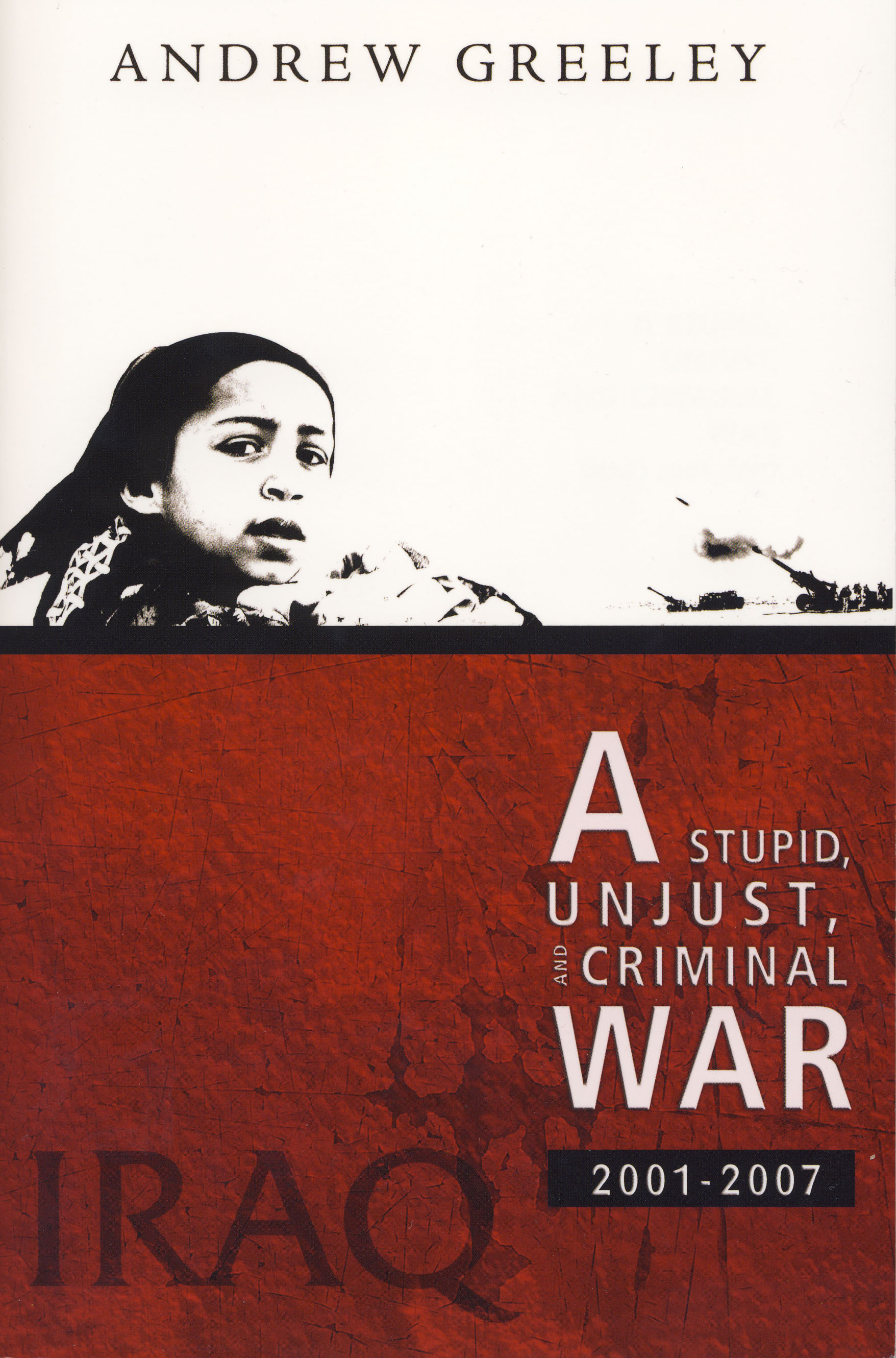
 A Stupid, Unjust, And Criminal War: Iraq 2001-2007 Father Greeley calls to task those who justified, planned and executed the war and reminds us that God weeps at the destruction of war, whether lives lost are ‘ours’ or ‘theirs.’  Order
Book Read
ReviewsRead
the IntroductionLarger
Image of CoverPress
Release Order
Book Read
ReviewsRead
the IntroductionLarger
Image of CoverPress
Release |
||
|
Read Father Greeley's latest
Articles: |
||||