|
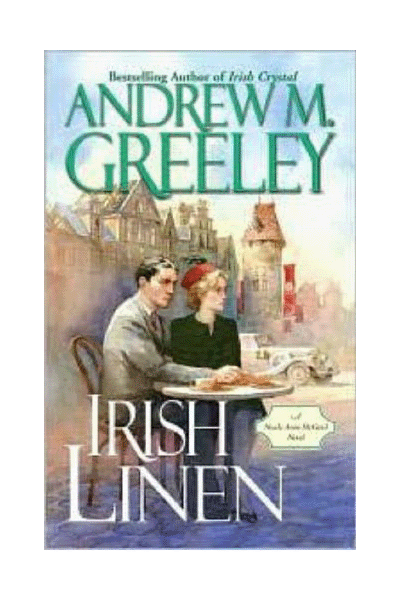
The book is dedicated to Father Greeley and has a
chapter about him.
Mike had these
wonderful things to say about Father Greeley in the
CatholicMom interview: July
“Andrew Greeley was already a famous Catholic writer
when I was in the
seminary and when he read something I wrote in a
literary magazine Fr. Greeley wrote to me and
encouraged me to continue writing! When I went to
him as a young priest and told him I wanted to leave
and get married and asked him if he’d write a letter
of introduction to his publishers in New
York, he did, even though he offered to find me a
psychiatrist first (I found my own seven years
later). Andy wrote books for me my whole career as
an editor and publisher, like The Great Mysteries,
that were among the best
I
ever did and the best he ever wrote. He is one of
the kindest men I’ve ever known.
He was getting out of a taxi a couple of years ago
and his coat
caught in the door and he cracked his skull on the
pavement and will probably never write another book.
Andrew Greeley is one of the great
Catholic minds of the latter 20th century, but I
will always remember him as one of the great
Catholic hearts.”
This is a wonderful book!
For more interest, recent comments, and ordering
check out:
CatholicMom and
Fr Greeley’s Amazon Portal

What’s Right With the Church Thomas
Groome | APRIL 4, 2011
I would never leave, even if
they should try to kick me out. That may be as much Irish
pigheadedness as genuine faith. But I have lots of friends and
family who already have left or who often threaten to leave the
Catholic Church. This breaks my heart. With some 30 million
former Catholics in the United States alone, I meet lots of them
along the way—on planes and trains, at family wakes and
weddings. My first instinct always is to try to convince them,
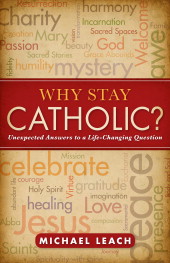
as Michael Leach advises, that instead of “throwing the baby out
with the bathwater” they might reconsider and recognize that
“The baby [Catholic faith] is precious, it’s real, it never
grows old, can still give joy, peace, and assurance, and it’s
not dependent on people.” Now I also have a great book for them
to read. Why Stay Catholic? might well convince exiles to
return and the wavering to remain.
In the spirit of James Joyce’s definition of catholic as “here
comes everybody,” Leach makes a powerful argument for a big-tent
Catholicism: “there is room in the church for everyone, or there
is room for no one...for those who save their money for a
pilgrimage to Medjugorje and for those who blow it at Vegas, for
sinners, saints, and fools.” In that light, I thank God with
renewed confidence for my own welcome.
The author—publisher emeritus and editor at large of Orbis
Books—divides this fun book into three sections, around ideas,
people and places that epitomize Catholicism. The ideas rise up
afresh out of “the great deposit of faith”; but this “is not a
limited checking account; it’s a trust fund that increases and
multiplies.” His key conviction, repeated often throughout, is
God’s unconditional love for every person. His central Scripture
text is Rom 8:38-39, that nothing can separate us from the love
of God in Christ Jesus.
The “People” section has stories of some persons well known to
all and others better known to Leach who incarnate the Catholic
faith. Many of his heroes are mine as well: Thea Bowman, Miriam
Therese Winter, Dorothy Day, Bishop Ray Lucker, Andrew Greeley
and now the author’s spouse, Vickie (for battling illness with
faith and courage). Under “Places,” where the word gets made
flesh again, he reviews parishes (like Old St. Pat’s, Chicago),
schools, hospitals, monasteries, Catholic Charities, Catholic
Relief Services and the Los Angeles Religious Education
Congress, among others.
In my view, the two best reasons for staying Catholic, as the
book stresses, are the twin principles of incarnation and
sacramentality. Of course, Catholicism is incarnational in its
focus on Jesus. Leach is convinced that the Jesus event and his
paschal mystery is not about a God who needed to be appeased for
our sins but one who came looking for us out of love.
Catholicism is particularly incarnational, however, in that it
encourages people to enflesh their faith, to realize it in their
lives, far beyond the purely confessional. This is why he
emphasizes people and places who concretize it. And even the
ideas that he highlights all lead to practices of one kind or
another; Catholic Christian faith must get done “on earth as in
heaven.”
The other side of the incarnational coin is the sacramental
nature of Catholic faith. Again, this emphasis reaches a climax
in the seven great liturgical sacraments that we celebrate in
church, but these arise from and flow back into the
sacramentality of the ordinary and everyday of life. Because
“God is everywhere,” God looks for us and we respond through our
lives in the world. In the words of St. Augustine, “If you have
an eye for it, the world itself is sacramental.” It is the
sacramentality of Catholic faith that makes it so humane, so
life-giving. “Catholicism seen through the eye of a needle is a
religion of rules and regulations. Seen with the sacramental
imagination, it is a unique take on life, a holy vision, a way
of seeing the chosen part of things.”
These twin principles—the incarnational and sacramental—are what
make Catholicism most worthwhile, why anyone can well stay,
regardless of disappointments and complaints and the scandals
that beset the church. Indeed, these very principles lend
Catholic faith its rich spiritualities; “When it comes to
spirituality, “the author writes, “the Catholic Church is a
Garden of Eden.”
These principles also explain why we love to tell the stories of
faith, old and new, and why Catholics can often have a little
more fun. “Catholics like to get together and eat cholesterol
and drink beer and have fun.” This book itself oozes with the
incarnational and sacramental, providing many laughs and a few
tears while reading it. I learned, for instance, that “Americans
trust angels ten times more than they do their congressmen. That
makes sense.”
Meanwhile, Leach pulls no punches when it comes to the church’s
shortcomings; his book is anything but a whitewash. In fact, it
is brutally honest. Yet it is also long on hope, perhaps the
theological virtue most needed now. He is convinced, for
example, that the great controversies that beset our time
concerning ministry (e.g., optional celibacy, women’s
ordination) will all be solved in good time, and people will
wonder what all the fuss was about. Just like that!
Treat yourself and your friends, whether staunch, wavering,
recovering or in exile, to this inspiring book. It forcefully
makes the case for staying; it will also “bring the smile back
to [your] Catholicism, the kind that comes from deep in your
heart....”
Thomas Groome is professor of
theology and religious education at Boston College’s School of
Theology and Ministry, where he also is chair of the department
of religious education and pastoral ministry.
Order now
 |
Hardcover:
224 pages |
|
|
Publisher:
Transaction Publishers (April, 2011) |
|
|
Language: English |
|
|
$14.95 |
|
Fr. Greeley's Last Book:
Chicago
Catholics and the Struggle with Their Church
The survey of the archdiocese, which Father
Greeley describes as "a very complicated place" demographically, asks some
difficult questions, and finds some interesting truths.
 Editorial
Review
Cover
Image Editorial
Review
Cover
Image
Order
Book
Other very popular books by Father Greeley include:
Irish Linen
Order
Book
Read
Reviews
Image of Cover

The Book Of Love
A reflection of love.
Read sleeve notes
Order
Book
Irish Tweed
Order
Book
Read
Reviews
|